





Website by 
Resources
Storm Damage: What Rochester Homeowners Should Do in the First 48 Hours
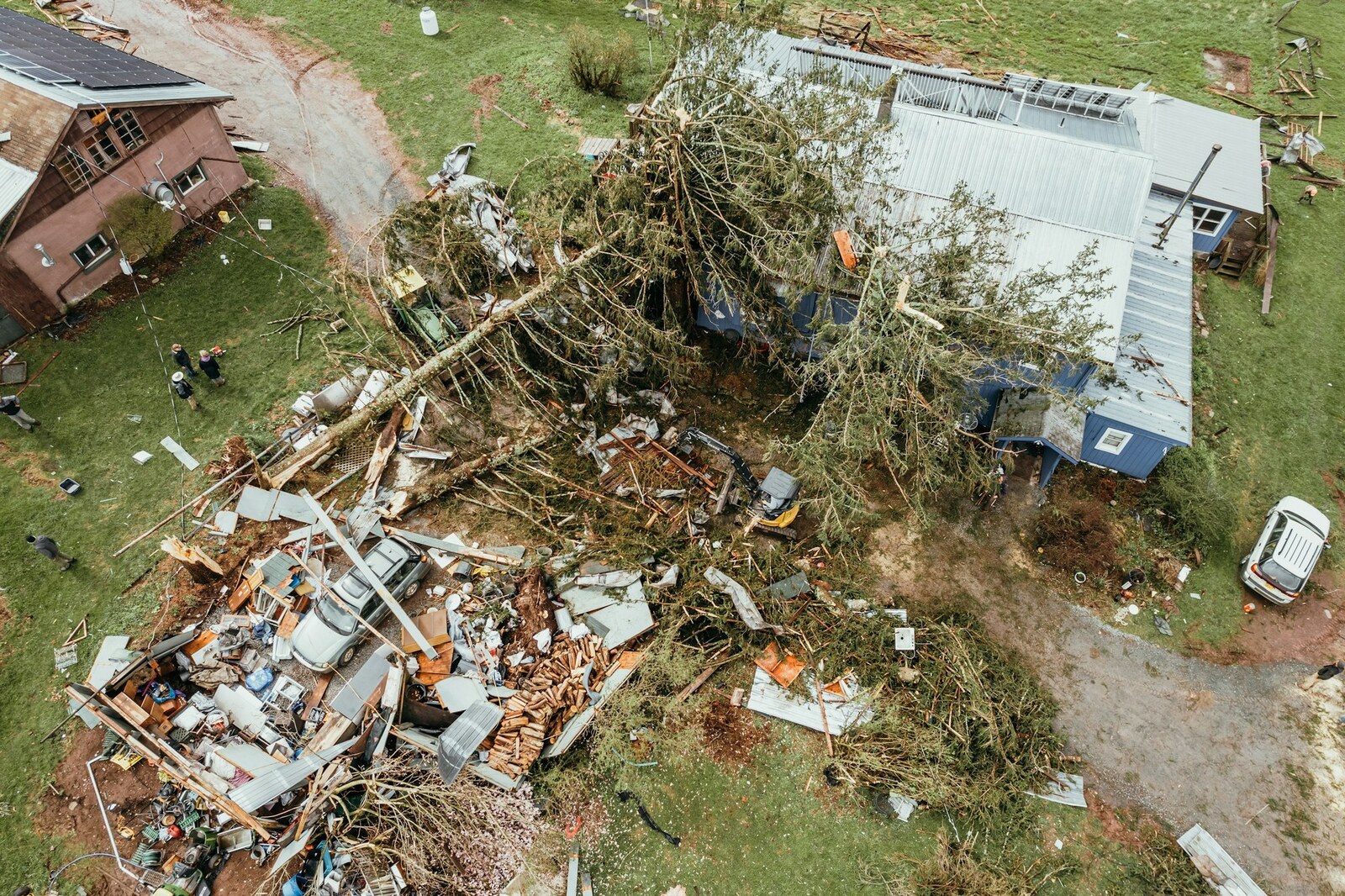
Wednesday night's line of storms moved through Western New York fast and left a mess behind it. Tornado warnings went up across the Rochester area and a tornado watch covered the region until eleven. News 8 meteorologists tracked radar-indicated winds around 70 miles per hour near Bethany and along Route 20 in Genesee County. There was hail, flash flooding in low-lying areas, trees down, and power out across a wide stretch of the region. One of the photos going around shows a tree sitting on a house on Klem Road in Webster.
This morning a lot of people are walking their property with a coffee in one hand, looking up at the roof and wondering how bad it is. Here is what to do, in the order it should be done, from a contractor who lives and works here.
First: Safety, Before Anything Else
Nothing on your house is worth an injury. Before you assess a single shingle:
- Stay away from downed power lines. Assume every line on the ground is live, including ones lying on a fence, a tree, or a car. Do not touch anything they are touching. Report them and keep everyone, including pets, well clear.
- If you smell gas, leave immediately and call from somewhere else.
- Do not get on the roof. Wet, possibly damaged, possibly with hidden soft spots. Almost everything you need to see can be seen from the ground with binoculars or from inside the attic.
- Watch for structural instability. A tree resting on a roof is holding load. Removing it wrong can do more damage than the storm did, or drop the structure. That is a job for people with the right equipment.
- Be careful with standing water in a basement, particularly near an electrical panel, a furnace, or anything plugged in. Kill the power to that area before wading in, or get someone who can.
- Generators outside only, well away from windows and doors. Every year people are hurt by carbon monoxide after a storm, not by the storm.
Second: Document Everything Before You Touch It
This is the step people skip in the rush to clean up, and it is the one that costs them money later. Your insurance claim will be built on what you can show.
- Photograph and video everything before you move, clean, or repair anything. Wide shots that establish the whole property, then close-ups of each area of damage.
- Get the date and time into the record. Most phones do this automatically, and it matters, because a claim can hinge on damage being tied to a specific storm event.
- Photograph the inside too. Water stains on ceilings, wet insulation, damaged flooring, ruined contents.
- Do not throw damaged materials away. Keep the shingles that came off, the section of siding, the broken window. An adjuster may want to see them.
- Write it down while it is fresh. What happened, when you noticed each item, what you did about it.
- Keep every receipt for tarps, plywood, a hotel if the house is not liveable, anything you spend responding to this. Emergency mitigation costs are frequently reimbursable.
Third: Stop the Water
Insurance policies generally expect you to take reasonable steps to prevent further damage. More to the point, water that keeps coming in turns a manageable repair into a much larger one.
A tarp over a compromised roof section, plywood over a broken window, a bucket and a poked drainage hole in a bulging ceiling. Temporary is fine. Temporary is the goal. Do not undertake permanent repairs before the adjuster has seen it, but absolutely do stop the ingress. Document the temporary work with photographs too.
If the damage is beyond a tarp you can safely place from a ladder, call someone. Ember Works can get emergency protection on your home and we are answering the phone at 585-465-1674.
Fourth: Call Your Insurance Company
Call sooner rather than later. After a regional event, adjusters get booked quickly and the queue only grows.
When you call, get your claim number and write it down, ask what your policy requires of you and by when, and ask specifically how the policy treats roof damage, because coverage varies considerably between replacement cost and actual cash value, and that difference can be substantial on a roof. Ask about your deductible, and whether wind and hail carry a separate one, which some policies do.
You are entitled to have a contractor present when the adjuster inspects. It is generally a good idea. An adjuster is assessing a lot of properties quickly, and having someone there who works on roofs for a living, pointing out what is easy to miss from a ladder, tends to produce a more complete assessment.
What to Actually Look For
Storm damage is not always dramatic. The damage that causes the most expensive problems is frequently the damage that looks like nothing.
Roof: missing, lifted, cracked or curled shingles. Shingles that look fine but have lost their granules, leaving darker patches. Exposed nail heads. Damaged or displaced flashing around chimneys, vents and valleys. A ridge line that looks uneven. Debris impact marks.
Hail specifically: this is the one homeowners miss. Hail bruising on an asphalt shingle often looks like a small dark spot with the granules knocked away, and it can feel soft, like a bruise on fruit. It rarely leaks straight away. What it does is destroy the shingle's protective layer and take years off its life, so the failure arrives two or three winters later and by then the claim window is long closed. If there was hail at your address, get someone up there who knows what hail damage looks like.
Siding: cracks, holes, dents, chips, and panels pulled loose at the seams. Hail dents on vinyl and aluminum. Anything that has opened a path behind the siding, because that is where the real damage happens quietly.
Windows: cracked or broken panes are obvious. Less obvious is a seal broken by impact or pressure change, which shows up weeks later as fog or condensation between the panes. Check frames, sills and screens too.
Gutters and downspouts: dents, sections pulled away from the fascia, seams separated. A large amount of granules in the gutters after a hail storm is a strong signal about the roof above.
Inside the attic: often the most informative ten minutes you will spend. Lights off, look for daylight through the boards. Look for wet sheathing, drips, water stains on rafters, and wet or matted insulation.
Everything else: soffit and fascia, chimney and its flashing, skylights, the air conditioning condenser, where hail flattens the fins and hurts efficiency, and fences, decks and outbuildings.
The Part We Need to Warn You About
Within a day or two of a storm like this, people will start knocking on doors across the affected neighborhoods. Some of them are legitimate local companies. A lot of them are not, and Western New York gets a fresh wave after every significant event.
The pattern is consistent. They arrive from out of the area, they work fast and cheap, they take a deposit or an insurance payment, the workmanship is poor, and they are three states away by the time the problems appear. There is no one to call on the warranty because the company no longer exists in any meaningful sense.
Walk away if you hear any of this:
- "We can waive your deductible" or "we'll cover it for you". This is not a discount. Absorbing a deductible on an insurance claim is fraud, and the homeowner is exposed too, not just the contractor.
- "Sign here so we can do a free inspection." Read what you are signing. It is sometimes an assignment of benefits or a contract that hands over your claim, or commits you to using that company regardless of what you find out later.
- Pressure to decide today. A legitimate contractor is happy to leave you a written proposal and let you think.
- A large cash deposit up front, particularly before materials are ordered.
- No local address, a phone number that goes to voicemail, out-of-state plates, and a business name that is hard to find anything about.
- "Your roof is destroyed" after a two minute look from the driveway.
Ask any contractor these questions: Where is your local address? Are you licensed and insured in New York, and can I see the certificates? Can you give me references on streets near me? Who will actually be doing the work, employees or subcontractors? What is the warranty and who honors it? Will you be here in five years if something goes wrong?
A local company will answer all of that without hesitating.
One More Thing on Insurance
Be straight in your claim. Do not let anyone encourage you to include damage that was not caused by this storm, to exaggerate, or to describe old wear as new. It is fraud, it is your name on the claim, and it can void your coverage when you genuinely need it.
The flip side is equally true. Do not let damage go unclaimed because it is not obvious. Hail bruising and lifted shingles are real damage with real financial consequences, and they are exactly what a quick inspection misses.
We Are Here, and We Are Local
Ember Works installs windows, siding and roofing, and we are based at 849 Paul Rd in Rochester. Not a call center, not a crew passing through after the weather.
If your home took damage on Wednesday night, call us and we will come out and tell you honestly what we see, at no charge. If it needs work, we will quote it and we will meet your adjuster on site. If it does not, we will tell you that too, and you will have an accurate picture of your house for nothing.
Our build team brings 60 plus years of combined hands-on experience, and the people who assess your home are the people who do the work. Ember Works serves Rochester, Monroe County, and all of Western New York.
Ignite Your Home's Potential with Ember Works!
Call us today: 585-465-1674
Contact Us: www.emberworksroc.com/contact-us
Ready to Start Your Kitchen or Bathroom Project?
Ember Works is a design‑build firm in Rochester, NY. Our designers and our build team work under one roof, so you get a realistic budget before anything is drawn and one team accountable from the first sketch to the final walkthrough. We design and build custom kitchens and dream primary bathrooms across Rochester, Monroe County, and Western New York, backed by 60 plus years of combined hands-on experience.
‹ Back
Recent Posts
-

Inside the Cabinets: Pull-Outs and Fittings That Earn Their Keep
October 16, 2026
-
Sump Pumps and Backup Power: Basement Insurance Before Winter
October 13, 2026
-

Shower Waterproofing: The Membrane Behind Your Tile You Never See
October 10, 2026
-

Two Cooks, One Kitchen: Designing a Layout That Does Not Collide
October 7, 2026
-

Wet Rooms: The Shower-and-Tub Layout Gaining Ground in Rochester
October 4, 2026