



Website by 
Resources
Cabinet Hardware and Mixing Metals: Small Choices, Big Difference
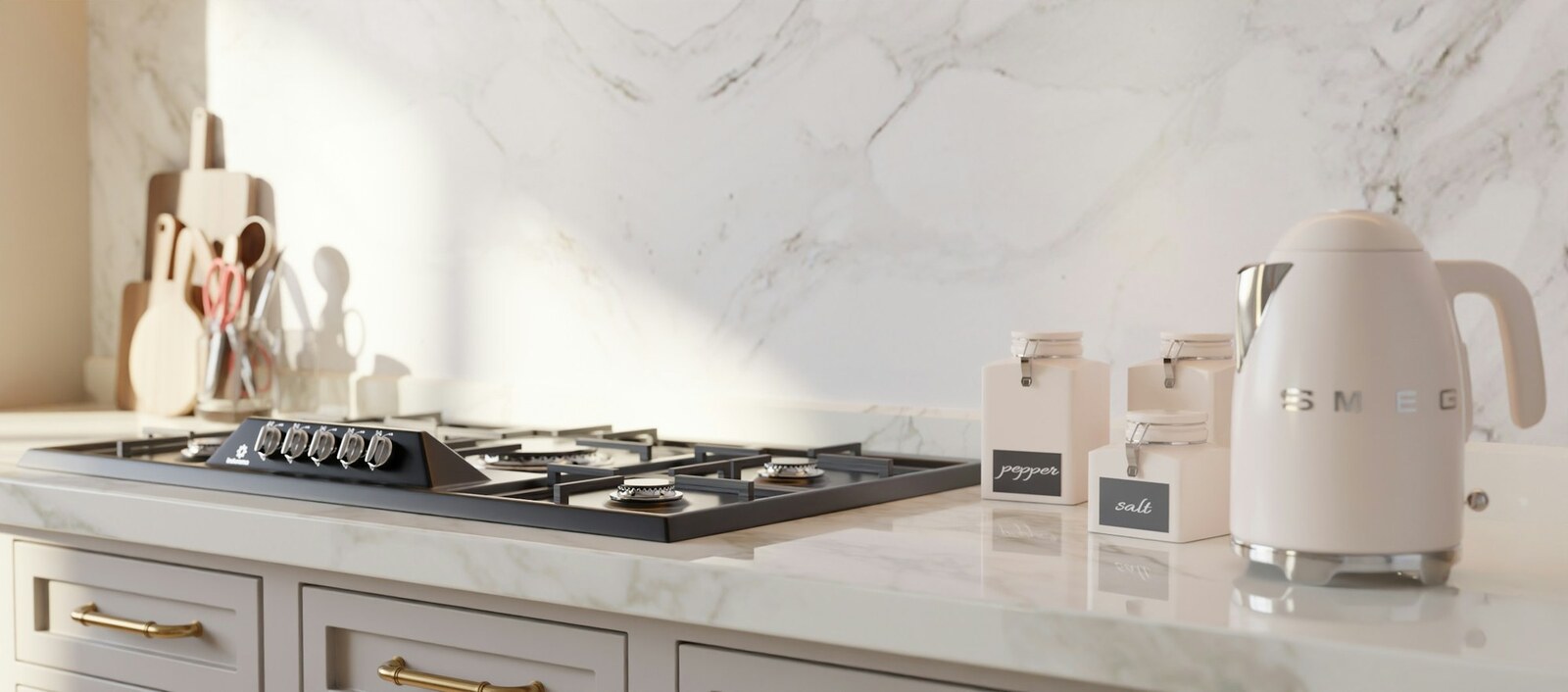
Cabinet hardware is the last thing chosen in most kitchen projects and the first thing anyone touches. It is also the cheapest way to change how a kitchen reads, and the easiest thing to get subtly wrong in a way that nags at you afterwards.
Two questions come up constantly: what should I choose, and can I mix metals? Here are honest answers to both.
Yes, You Can Mix Metals
The old rule that every metal in a room must match is gone, and good riddance, because it produced flat rooms and it was never how well-designed spaces actually worked. Mixing is now standard practice. It just needs a bit of structure or it looks accidental rather than intentional.
Three principles that make it work:
- Two metals, occasionally three. Not five. Pick a dominant metal and one accent. The dominant one carries most of the room; the accent appears deliberately in a couple of places.
- Repeat each metal at least twice. A single brass item in a room of chrome looks like a mistake. The same brass on the faucet and the pendant lights reads as a decision. Repetition is what signals intent.
- Keep matching things matched. Items that sit right beside each other and do the same job should agree. The faucet and the soap dispenser at the same sink should match. Cabinet knobs and pulls throughout one run should match. Contrast between categories, not within them.
The combinations that consistently work: warm brass with matte black, brushed nickel with matte black, and polished chrome with brass. A useful approach in a kitchen is warm metal on the cabinetry and lighting, and a cooler practical metal at the sink where hard water is going to be a factor.
The Finishes, and How They Behave in Rochester
Much of our region has hard water, which affects finishes more than fashion should:
- Polished chrome. The most durable finish there is, cheap, and it hides water spots better than almost anything. It reads slightly dated to some eyes, which is more a matter of context than fact.
- Brushed or satin nickel. The safe default for a reason. Warm-toned, hides fingerprints and spots well, widely available.
- Matte black. Looks superb and shows every fingerprint, water spot, and speck of dust. Genuinely beautiful in the right kitchen; be prepared to wipe it. Quality varies a lot and cheap versions wear through at the edges.
- Unlacquered brass. A living finish that darkens and patinas with handling. People either love this or are horrified by it, so know which you are before committing. It suits Rochester's older homes exceptionally well.
- Lacquered or satin brass. Holds its colour and does not patina. The pragmatic version of the brass look.
- Oil-rubbed bronze. Dark and warm, wears at the high points over time, which is either character or damage depending on your view.
Knobs, Pulls, and Sizing
The practical guidance that makes a kitchen feel right:
- Pulls on drawers, knobs or pulls on doors. Drawers, especially heavy ones full of pans, are much easier to open with a pull you can get a hand around. This is a functional point, not an aesthetic one.
- Scale the pull to the drawer. A small pull on a wide, deep drawer looks mean and pulls unevenly. A rough guide is roughly a third of the drawer width, and wide drawers often want two pulls.
- Appliance pulls for panelled refrigerators and dishwashers need to be substantially heftier than cabinet pulls, or they look undersized.
- Think about hands. A pull with a smooth generous profile is easier for arthritic hands than a small knob, and considerably easier with wet or greasy fingers. This is worth weighing if anyone in the house will benefit.
- Consistent placement. Hardware placed by eye rather than by jig is immediately visible across a long run. This is an installation quality issue as much as a design one.
- Edge pulls or integrated pulls give a handleless modern look, though they commit you to a specific door style.
Because hardware placement and appliance panel details are part of the cabinet order, they are best settled during design. Talk to Ember Works about your kitchen and we will coordinate hardware, fixtures, and lighting finishes so they read as one scheme.
Where the Metals Actually Appear
When planning a scheme, list every metal item in the room, because people forget several: cabinet knobs and pulls, the faucet, the sink itself if it is stainless, the pot filler, appliance handles and trim, light fixtures and pendants, switch and outlet plates, the range hood, and any open shelving brackets. Stainless appliances are a metal in the scheme whether you counted them or not, and they are usually the largest metal surfaces in the kitchen.
Switch plates are the most overlooked item and the cheapest to correct. A kitchen with beautiful brass hardware and builder-standard white plastic plates is undermining itself for the price of a few plates.
Buy One First
The single most useful piece of advice: order one sample of each hardware option before committing. Finishes photograph inaccurately and vary between manufacturers, and two products both called satin brass can be visibly different. Hold the sample against your actual cabinet door and your actual counter, in your own kitchen, in daylight and under your evening lighting. Ten dollars of samples prevents a costly and irritating mismatch across forty pieces.
Small Money, Visible Result
Hardware is a modest line on a kitchen budget and it is what your hand meets every time you open a drawer. Choose for feel as well as looks, mix metals deliberately rather than accidentally, and get samples before you order.
As a design-build firm, Ember Works coordinates hardware with fixtures, lighting, and appliances as a single scheme rather than a series of separate purchases. Our team, with 60 plus years of combined hands-on experience, drills and sets hardware to a jig so a long run lines up exactly. Ember Works designs and builds custom kitchens across Rochester, Monroe County, and Western New York.
Ignite Your Home's Potential with Ember Works!
Call us today: 585-465-1674
Contact Us: www.emberworksroc.com/contact-us
Ready to Start Your Kitchen or Bathroom Project?
Ember Works is a design‑build firm in Rochester, NY. Our designers and our build team work under one roof, so you get a realistic budget before anything is drawn and one team accountable from the first sketch to the final walkthrough. We design and build custom kitchens and dream primary bathrooms across Rochester, Monroe County, and Western New York, backed by 60 plus years of combined hands-on experience.
‹ Back
Recent Posts
-
Cabinet Hardware and Mixing Metals: Small Choices, Big Difference
November 22, 2026
-
Bathroom Mirrors and Vanity Lighting: Getting Ready in Good Light
November 19, 2026
-
Freestanding and Soaking Tubs: Worth It, or Worth Skipping?
November 16, 2026
-

Shower Niches, Benches, and Built-In Bathroom Storage
November 13, 2026
-
What Custom Cabinetry Actually Means (and When It Is Worth It)
November 10, 2026